|

POWER -
Although some countries act as though there is no energy crisis, in fact
they have departments for such matters, that are there to advise for how
much longer they can abuse their positions in world politics, to take
advantage of other countries and keep on killing species and warming the
planet - before their kleptocratic
inclinations are compromised.
The timeline for nuclear fusion moving from a laboratory experiment to a source of household electricity has shifted significantly in the last couple of years. While the old joke was that "fusion is always 30 years away," we are currently seeing a "split-track" race between massive international projects and agile private startups.
As of March 2026, here is the realistic theoretical timeline:
1. The "Aggressive" Private Track (2028–2035)
Several private companies, backed by billions in investment (largely driven by the massive energy needs of AI and data centers), are aiming for much faster results than government projects.
Late 2020s (2028-2030): Companies like Helion Energy have signed power purchase agreements (e.g., with Microsoft) to provide fusion-generated
electricity as early as 2028. While many experts remain skeptical of such a tight deadline, Helion broke ground on its "Orion" facility in 2025 and is currently testing its "Polaris" prototype.
Early 2030s: Commonwealth Fusion Systems (CFS) is working toward its "ARC" power plant, which they aim to have grid-connected in the early 2030s. Their strategy relies on high-temperature superconducting (HTS) magnets, which allow for much smaller and cheaper reactors.
2. The "Scientific" Institutional Track (2035–2050)
The large-scale, multi-nation projects focus on proving the physics is "bankable" before building commercial plants.
2034–2039: ITER (the world's largest fusion project in France) recently updated its baseline. It now expects to start scientific research operations in 2034, with full deuterium-tritium fusion (the "real" stuff) beginning in 2039.
2040s: Following ITER, projects like the STEP program in the UK and DEMO in Europe are designed to be the first "demonstration" plants that actually put significant power into the national grids.

CURRENT THEORETICAL HURDLES
While we've proven we can create the reaction, three "boring" engineering problems are what actually dictate the timeline:
1. Tritium Breeding: We need to create a way for the reactor to "grow" its own fuel (tritium) internally using lithium blankets.
2. Material Science: We need metals that can survive being bombarded by high-energy neutrons for years without becoming brittle or overly radioactive.
3. Heat Management: Moving the intense heat from the plasma to a steam turbine without melting the machine itself.
In short: If you are looking for fusion to lower your electricity bill, you’re likely looking at the late 2030s or early 2040s. However, we are currently in the "Kitty Hawk" phase of fusion—the flight is short, but we are finally off the ground.
HIGH TEMPERATURE
SUPER CONDUCTING MAGNETS
The introduction of High-Temperature Superconducting (HTS) magnets is widely considered the "transistor moment" for fusion energy. Before these magnets, the only way to get more power out of a reactor was to make the reactor physically larger—a path that led to the massive, multi-billion-dollar scale of projects like ITER.
Here is how these "super magnets" are fundamentally shrinking the footprint and accelerating the timeline:
1. The Power of the "Fourth Power"
In fusion physics, the amount of fusion power you can generate is proportional to the magnetic field strength raised to the fourth power (P∝B4).
The Math: If you double the magnetic field strength, you don’t just get double the power—you get 16 times the power (24=16).
The Result: Because HTS magnets can create much stronger fields (often reaching 20+ Tesla compared to the ~5–12 Tesla of older magnets), you can pack the same amount of "fusion punch" into a much smaller volume.
2. Radical Downsizing: ITER vs. SPARC
To see the impact of this technology, look at the size comparison between the world's leading "old tech" reactor and the "new tech" prototype:

By using HTS magnets, companies like Commonwealth Fusion Systems (CFS) are building reactors that can fit inside a medium-sized warehouse rather than requiring a dedicated industrial campus.
3. Easier Cooling (The "High Temperature" Part)
Don't let the name fool you: "High Temperature" in this context still means roughly -250°C (20 Kelvin). However, this is significantly "warmer" than the -269°C (4 Kelvin) required by older magnets.
Old Tech: Requires liquid helium, which is rare, expensive, and incredibly difficult to manage.
New Tech: Can use liquid hydrogen or neon, which are cheaper and easier to circulate. This simplifies the plumbing of the reactor, making it more reliable and less prone to expensive "quenches" (where the magnet loses its superconductivity).
4. Modular Construction
Because these reactors are smaller, they can be factory-built. Instead of spending 20 years pouring concrete on-site (like ITER), companies can manufacture the magnet "pancakes" and vacuum vessels in a factory and ship them to the site.
UK Innovation: The UK's Tokamak Energy recently demonstrated their "Demo4" magnet system in late 2025, proving that these compact magnet sets can handle the immense forces required for a power plant while being small enough to be maintained or replaced far more easily than traditional designs.
What’s the catch?
The main challenge now isn't the magnetism—it's structural. At 20 Tesla, the magnetic pressure is so intense it wants to "blow the magnet apart" with a force equivalent to several times the pressure at the bottom of the Mariana Trench. Engineers are currently using advanced steel "exoskeletons" to keep these super magnets from deforming under their own power.
SPHERICAL TOKAMAK PROJECT
The UK’s STEP (Spherical Tokamak for Energy Production) project is currently the global frontrunner for "institutional"
fusion. Its goal is to replace the old West Burton coal power station in Nottinghamshire with a fusion plant by 2040.
Just this month (March 2026), the UK government officially moved the project from the "research" phase to the "delivery" phase. Here is how they are making "Fossil to Fusion" a reality:
1. The "Spherical" Advantage
Unlike the massive, donut-shaped ITER reactor in France, the UK is betting on a Spherical Tokamak.
The Shape: It looks more like a cored apple than a donut.
The Benefit: This compact shape allows the magnetic field to be much more efficient. By using the HTS "super magnets" we discussed, the UK can build a reactor that is significantly smaller and cheaper while still aiming to put 100+ Megawatts of net electricity onto the grid.
2. Modernizing "Megawatt Valley"
The area around the River Trent has been known as "Megawatt Valley" for 60 years because of its concentration of coal plants.
Site Reuse: West Burton was chosen specifically because it already has the "heavy lifting" infrastructure: massive grid connections, cooling water access from the River Trent, and rail links.
The Milestone: On March 16, 2026, the government appointed the ILIOS Consortium (led by Kier and Nuvia) as the official construction partner. They are now tasked with the £200 million redevelopment of the brownfield site to prepare for the reactor.
3. AI and the "Sunrise" Supercomputer
One of the most recent 2026 updates is the launch of Sunrise, a mission-focused
AI
supercomputer.
The Purpose: Fusion plasma is notoriously "wiggly" and hard to predict. Sunrise uses AI to simulate and stabilize the plasma in real-time.
The Impact: This reduces the need for years of physical trial-and-error, effectively "speed-running" the engineering challenges of the 2030s.
4. The Economic "Supercluster"
The project isn't just a lab; it’s being treated as an industrial "supercluster" involving three former coal sites:
West Burton: The Fusion Reactor.
Cottam: Targeted for Small Modular Reactors (SMRs).
High Marnham: Focused on clean hydrogen.
The Goal: This "Trent Supercluster" is expected to create 10,000 jobs by 2030 and add nearly £1 billion to the local economy annually.
The Timeline from Today:
2026–2029: Site preparation, building of R&D test facilities, and final engineering designs.
2030: Major plant construction begins on-site.
2040: Target for the first "pulse" of fusion power to hit the UK National
Grid.
It’s a poetic transition: the very same site that powered the UK with fossil fuels for 57 years is now being prepped to provide the "limitless" energy of the future.
TRITIUM
To understand fusion, you have to understand its "battery"—and that is Tritium.
While Deuterium is the easy half of the equation (abundant in seawater), Tritium is the rare, "magic" ingredient that makes the reaction actually work at temperatures we can manage on Earth.
1. What is Tritium? (The Properties)
Tritium is a radioactive isotope of hydrogen. While a normal hydrogen atom has one proton and zero neutrons, Tritium has one proton and two neutrons.
Appearance: Like hydrogen, it’s an odorless, colorless gas.
Radioactivity: It is unstable and decays over time. It has a half-life of 12.3 years, meaning if you store a kilogram of it today, in 12 years you’ll only have half a kilogram left.
Safety: It emits very weak "beta" radiation. It’s so weak it cannot even penetrate human skin, but it is hazardous if inhaled or swallowed in large amounts.
2. Why is it the "Best" Fuel?
In theory, you could fuse many things, but the Deuterium-Tritium (D-T) reaction is the undisputed champion for two reasons:
Lower "Ignition" Temperature: Other fusion reactions require billions of degrees. The D-T reaction "only" requires about 150 million°C. In the world of physics, that’s considered "easy."
Energy Density: It is incredibly powerful. Just 1 gram of D-T fuel releases the same energy as burning 11 tons of coal.
3. The "Tritium Crunch": Where do we get it?
This is the biggest hurdle in fusion right now. Tritium is almost non-existent in nature (created only by cosmic rays hitting the upper atmosphere).
Current Source: Almost all of the world's commercial Tritium comes as a byproduct of CANDU (fission) nuclear reactors, mostly in Canada and South Korea.
The Problem: The global supply is tiny—only about 20–30 kg exists in the entire world. A single commercial fusion plant would need about 50 kg per year.
4. The Solution: "Breeding" Fuel from Rocks
Because we can't "mine" Tritium, fusion plants must be self-sufficient. They will "breed" their own fuel using Lithium (which is abundant in the Earth's crust and oceans).
The Process: The inside of the reactor is lined with a "Breeding Blanket" containing Lithium.
The Magic Trick: When the fusion reaction happens, it shoots out high-energy neutrons. When these neutrons hit the Lithium in the wall, a nuclear reaction occurs that creates new Tritium atoms.
The Cycle: The reactor then sucks that new Tritium out of the wall and pumps it back into the center to keep the fire burning.
Recent 2026 Milestone: LIBRTI and H3AT
As of March 16, 2026, the UK government announced a major funding boost for two specific facilities to solve this:
LIBRTI (£180 million): A dedicated facility in the UK focused solely on Lithium Breeding. Its job is to ensure the STEP plant can create more fuel than it uses (aiming for a "Breeding Ratio" of 1.0 or higher).
H3AT: A partnership between the UK and Italy (Eni) to build the world's most advanced Tritium Loop. It’s essentially a giant "fuel processing" lab to figure out how to safely handle and recycle this gas at scale.
In a nutshell: We are moving from a world where we "buy" fuel to a world where we "grow" it inside the machine using simple lithium minerals.
WHY NOT STAY WITH THE SUN AND SOLAR PANELS?
If we have a giant fusion reactor in the sky (the Sun), why bother building "mini-suns" on Earth? The answer lies in the physics of how the Sun "cheats" and the economic reality of how we use power at night.
1. How the Sun "Cheats" (Gravity vs. Heat)
The Sun is a fusion reactor, but it works very differently from the ones we are building.
The Gravity Cheat: The Sun is so massive (333,000 times the mass of Earth) that its gravity crushes hydrogen atoms together at its core. Because of this immense pressure, it only needs a temperature of about 15 million°C to trigger fusion.
The Earth Challenge: We don't have that kind of gravity. To get atoms to fuse on Earth, we have to make up for the lack of pressure by cranking up the heat. This is why our reactors have to run at 150 million°C—ten times hotter than the center of the Sun.
The Efficiency Paradox: Surprisingly, the Sun is actually a very "slow" burner. Per cubic meter, the Sun’s core produces about the same amount of heat as a compost pile. It only generates massive power because it is unimaginably huge. On Earth, we need to be much more "efficient" to make a compact power plant.
2. Why not just use Solar Panels?
We are! Solar is currently the fastest-growing and cheapest energy source in history. However, solar has two "bottlenecks" that fusion is designed to solve:
A. The "Density" Problem
To power a major city like London or New York entirely on solar, you would need to cover thousands of acres of land in panels.
Fusion: A single fusion plant is roughly the size of a football stadium but produces the same power as millions of solar panels.
Siting: You can put a fusion plant right next to a city or a factory, whereas giant solar farms often have to be built far away, requiring expensive new power lines.
B. The "Baseload" Problem
Solar only works when the sun shines. To use it 24/7, you need massive battery storage.
The Cost Gap: As of 2026, the cost of solar panels is tiny, but the cost of the batteries needed to power a whole country through a week of cloudy winter weather is astronomical.
Fusion as "Baseload": Fusion is "firm" power—it’s always on, rain or shine. It acts as the "anchor" for the grid, allowing
solar and
wind to do the heavy lifting when they can, while fusion ensures the lights stay on at 3 AM in mid-January.
3. Cost Comparison: Tritium vs. Solar (2026 Forecasts)
In the energy world, we use LCOE (Levelized Cost of Energy) to compare different technologies over their lifetime. Here is how they stack up in the current market:
|
Technology
|
Estimated
Cost (per MWh)
|
Primary
Advantage
|
Main
"Hidden" Cost
|
|
Solar
(Utility Scale)
|
£40
– £55
|
Cheapest
"raw" energy.
|
Requires
batteries (£30+ extra).
|
|
Nuclear
Fission
|
£100
– £120
|
Reliable,
zero-carbon.
|
Waste
management & safety.
|
|
Fusion
(Projected)
|
£25
– £60
|
Limitless
fuel, compact.
|
Huge
upfront construction cost.
|
The "Tritium" Benefit: While a solar farm's "fuel" (sunlight) is free, the equipment degrades and takes up vast space. Fusion's "fuel" (Tritium/Lithium) is so energy-dense that a few truckloads could power a country for a year.
System Savings: Recent 2026 economic models suggest that adding fusion to a grid actually lowers the total cost for everyone by nearly £2 trillion globally by 2100. This isn't because the fusion electricity is "free," but because it prevents us from having to build an impossibly large number of batteries.
THE VERDICT
We aren't choosing between them; we need both. Solar is the "sprint" we are using to decarbonize the world right now. Fusion is the "marathon" technology that will eventually provide the massive, concentrated power needed for things like heavy industry, desalination, and even future space travel—things that are very difficult to do with sunlight alone.
WHAT
IS FUSION POWER?
Fusion power is a theoretical form of power generation in which
energy will be generated by using nuclear fusion reactions
from hydrogen to produce heat for electricity generation. In a fusion process, two lighter atomic nuclei combine to form a heavier nucleus, and at the same time, they release energy.
Today this is just a pipedream. But what a dream.
Fusion is the energy source of
the Sun and stars. In the tremendous heat and gravity at the core of these stellar bodies, hydrogen nuclei collide, fuse into heavier helium atoms and release tremendous amounts of energy in the process.
Twentieth-century fusion science identified the most efficient fusion reaction in the laboratory setting to be the reaction between two hydrogen isotopes, deuterium (D) and tritium (T). The DT fusion reaction produces the highest energy gain at the "lowest" temperatures.
Three conditions must be fulfilled to achieve fusion in a laboratory: very high temperature (on the order of 150,000,000° Celsius); sufficient plasma particle density (to increase the likelihood that collisions do occur); and sufficient confinement time (to hold the plasma, which has a propensity to expand, within a defined volume).
At extreme temperatures, electrons are separated from nuclei and a gas becomes a
plasma - often referred to as the fourth state of matter. Fusion plasmas provide the environment in which light elements can fuse and yield energy.
In a tokamak device, powerful magnetic fields are used to confine and control the plasma.

ITER
TOKAMAK - INTERNATIONAL
THERMONUCLEAR EXPERIMENTAL REACTOR
The heart of a tokamak is its doughnut-shaped vacuum chamber.
Inside, under the influence of extreme heat and pressure, gaseous hydrogen fuel becomes a plasma—a hot, electrically charged gas. In a star as in a fusion device, plasmas provide the environment in which light elements can fuse and yield energy.
The charged particles of the plasma can be shaped and controlled by the massive magnetic coils placed around the vessel; physicists use this important property to confine the hot plasma away from the vessel walls. The term "tokamak" comes to us from a Russian acronym that stands for "toroidal chamber with magnetic coils" (тороидальная камера с магнитными катушками).
To start the process, air and impurities are first evacuated from the vacuum chamber. Next, the magnet systems that will help to confine and control the plasma are charged up and the gaseous fuel is introduced. As a powerful electrical current is run through the vessel, the gas breaks down electrically, becomes ionized (electrons are stripped from the nuclei) and forms a plasma.
As the plasma particles become energized and collide they also begin to heat up. Auxiliary heating methods help to bring the plasma to fusion temperatures (between 150 and 300 million °C). Particles "energized" to such a degree can overcome their natural electromagnetic repulsion on collision to fuse, releasing huge amounts of energy.
First developed by Soviet research in the late 1960s, the tokamak has been adopted around the world as the most promising configuration of magnetic fusion device. ITER will be the world's largest tokamak
- twice the size of the largest machine currently in operation, with ten times the plasma chamber volume.
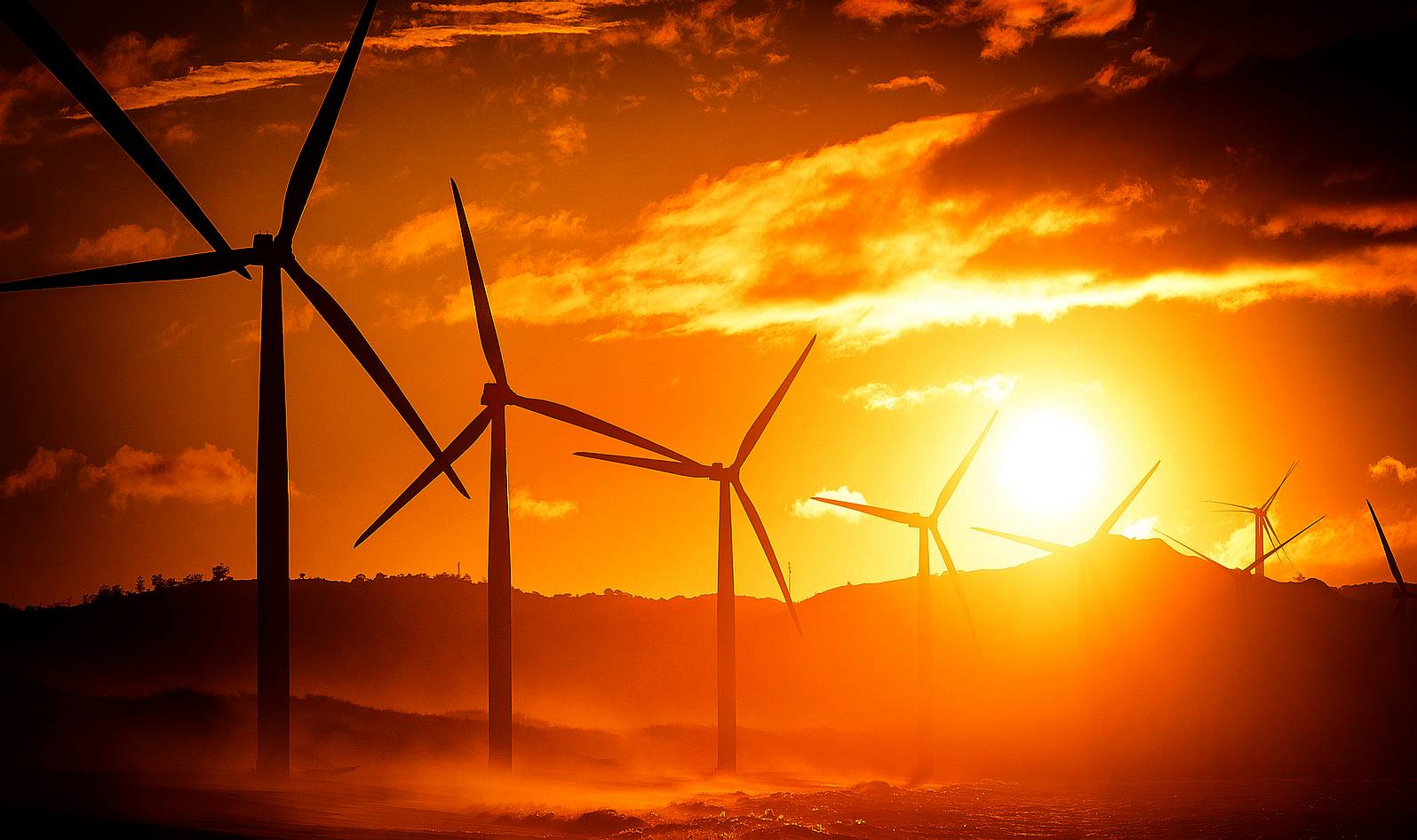
A
fantastic sight that happens all around the world every morning, hydrogen
fusion is happening in space to give us infinite energy. Sunrise
heralds the beginning of each new day. We can count our lucky stars that we
have this one to power life on earth.
CNBC
NEWS APRIL 2019 - Why Bezos and Microsoft are betting on this $10 trillion energy fix for the planet
Key Points:
* Jeff Bezos and others have sunk more than $127 million into General Fusion, a start-up trying to commercialize fusion energy.
* Microsoft is partnering with the company by offering technological know-how.
* Fusion occurs when two light atoms fuse together to make a heavier one, creating energy in the process. It’s the same process that powers the sun and stars.
* The goal is to provide energy to the 1 billion people on the planet that don’t have access to electricity.
Burnaby, British Columbia, is similar to most North American bedroom communities. The majority of its residents commute into neighbouring Vancouver every morning and then head back to their suburban homes at night. There is one thing, though, that sets it apart: Around the corner from one of the two Costcos in town is a small start-up that’s inching ever closer to solving the planet’s energy problems — and tapping into a yet untouched trillion-dollar market.
That start-up, General Fusion, isn’t like the up-and-coming companies you hear about in Silicon Valley, with eccentric founders, rapid growth and millions in revenues, though it does count Jeff Bezos, Microsoft and many others as investors and partners. Rather, it was started in 2002 by then 40-year-old physicist Michel Laberge, who quit a lucrative job at a
laser printing company to follow an unconventional passion: nuclear fusion development.
Laberge, who’s now the company’s chief scientist, was drawn to nuclear fusion because of its world-changing possibilities. Unlike nuclear fission, which involves splitting heavier atoms to create lighter ones and can produce radioactive waste, fusion produces no environmentally harmful gases, no nuclear waste, it can’t be made into a weapon, and it will never cause a power plant meltdown.
Fusion occurs when two light atoms fuse together to make a heavier one, creating energy in the process. It’s the same process that powers the sun and stars. It also uses deuterium, an atom that’s found in hydrogen, which is a key ingredient in water, so there’s little risk of running out of the atoms needed to make fusion. According to Live Science, a gallon of seawater can produce as much energy as 300 gallons of gasoline.
It’s no wonder, then, that people like Bezos and companies like Cenovus Energy have sunk more than $127 million into the company, according to Crunchbase, while billions
more dollars have been invested in about two dozen other nuclear fusion start-ups, government initiatives and big company projects, such as Lockheed Martin’s compact fusion reactor.
So far, no one has commercialized nuclear fusion, but the race is on to be the first to figure it out. Whoever does will be able to bring power to the more than 1 billion who don’t have access to electricity, power cars and help companies operate businesses without having to create harmful emissions.
They’ll also see a massive return on their investment.
“The market is infinitely large,” said Christofer Mowry, General Fusion’s CEO. “There’s nothing that will be more transformative to the energy space than fusion. It’s like how Facebook took over social media or if someone develops a truly practical autonomous vehicle.”
Fusion’s long life
The concept of fusion has been around for nearly a century, with the Russians making the first nuclear reactor in the 1960s to test various scientific theories.
While the concept has been proved, commercializing fusion remains elusive. Why? Because it’s a complex process that can only happen in 100 million degrees Celsius temperatures. Particles must also remain in close proximity with one another, and the plasma, which is ionized gas that’s created during the fusion process, must be contained or risk drifting away.
This process also has to be done cheaply and efficiently enough so that it can be used by people around the world.
“We do not have a reactor yet that is energy positive in terms of the outflow of energy,” said Ariel Cohen, a fusion expert and senior fellow at the Atlantic Council. “It takes so much energy to contain the plasma, but we’re hoping someone will be able to it and make it economically viable.”
What makes things more complicated is that there may be several ways to create the conditions for fusion to occur — and every company is trying something a little different.
Some, like the International Thermonuclear Experimental Reactor, a coalition of governments that are trying to make fusion viable, use the tokamak, which employs magnets to keep plasma from escaping and cooling off.
Others use lasers to rapidly compress hydrogen into frozen pellets that are 1000 times denser than ordinary matter and can achieve a momentary pulse of fusion.

General Fusion uses a hybrid of both, though it doesn’t use lasers. It injects plasma, which is surrounded by liquid metal, into a compression chamber where magnets help contain the gas. Then, pistons put pressure on the chamber to compress the plasma to fusion conditions. The now heated liquid metal gets turned into heat, which then gets turned into electricity.
Race to commercialization
It’s still an open question as to if, and when, fusion can be commercialized. Mowry said General Fusion has built all the components to create a reactor, but now it needs to develop a prototype, which will take five years.
“Using a car analogy, we built an engine, the transmission and the wheels; now we have to put it together and drive it down the road at full size,” he said.
It will take more time after that to build full-scale plants that can be used to power entire cities. If this were football, Mowry said he’d be on the 25-yard line.
Other companies have made varying degrees of progress. For instance, Commonwealth Fusion Systems, a commercial enterprise spun off by MIT, is about seven years away from creating a more energy-efficient Tokamak reactor.
In partnership with MIT, it is creating magnets out of rare-Earth barium copper oxide, which is a recently commercialized superconducting material. Could this be the ticket?
“We need to design the next-generation machine ... that can produce more fusion power than energy needed to heat it,” said Dr. Martin Greenwald, deputy director of the MIT Plasma Science and Fusion Center. “We think we can do that in a relatively short amount of time.”
Even when its components are created — it is currently in the R&D phase and likely won’t start building components for another two-and-a-half years, said Greenwald — it will still need to create a pilot plant to see if it works. Then it needs to commercialize it, he said.
Lockheed Martin, with its decades of engineering experience and government connections, hopes to unlock fusion’s power by creating a compact reactor that’s 10 times smaller than existing reactors. It will be so small that it will fit on the back of a truck, it says on its website.
While the company declined an interview, it says online that it’s trying to mimic the way sun creates fusion. Its cylindrical reactor, which it calls a small magnetic bottle, is similar to a tokamak, but it’s much smaller and uses different magnetic technology.

Lockheed has been mum on its progress, but Cohen said that while it’s not a pipe dream, it may not be that close to reality, either.
“This is a field that’s proved over decades to be difficult to master,” he said. “Every 10 years there’s chatter of how we’re going to be close to a breakthrough, and I really hope we are.”
Greenwald, though, thinks the industry is getting closer to putting all the pieces together. Of course, he thinks MIT’s magnetic technology is going to work, but more importantly, he just wants someone to bring this technology to the public.
“Fusion is too important for just one shot on goal,” he said. “Just like when you’re developing pharmaceuticals, it’s good that people are trying different approaches.”
Mowry, who is also confident that his technology will be first to market, agrees the more the merrier. While the attempt to commercialize has been going on for decades, he doesn’t think companies or investors will get tired of waiting.
“Investors love it,” he said. “It answers the existential challenge of
climate change, which motivates a lot of private investors. They like that fusion can’t make a bomb and there’s no long-term waste, and they like that they can access a $10 trillion market opportunity. It’s a great story.”
By Bryan Borzykowski
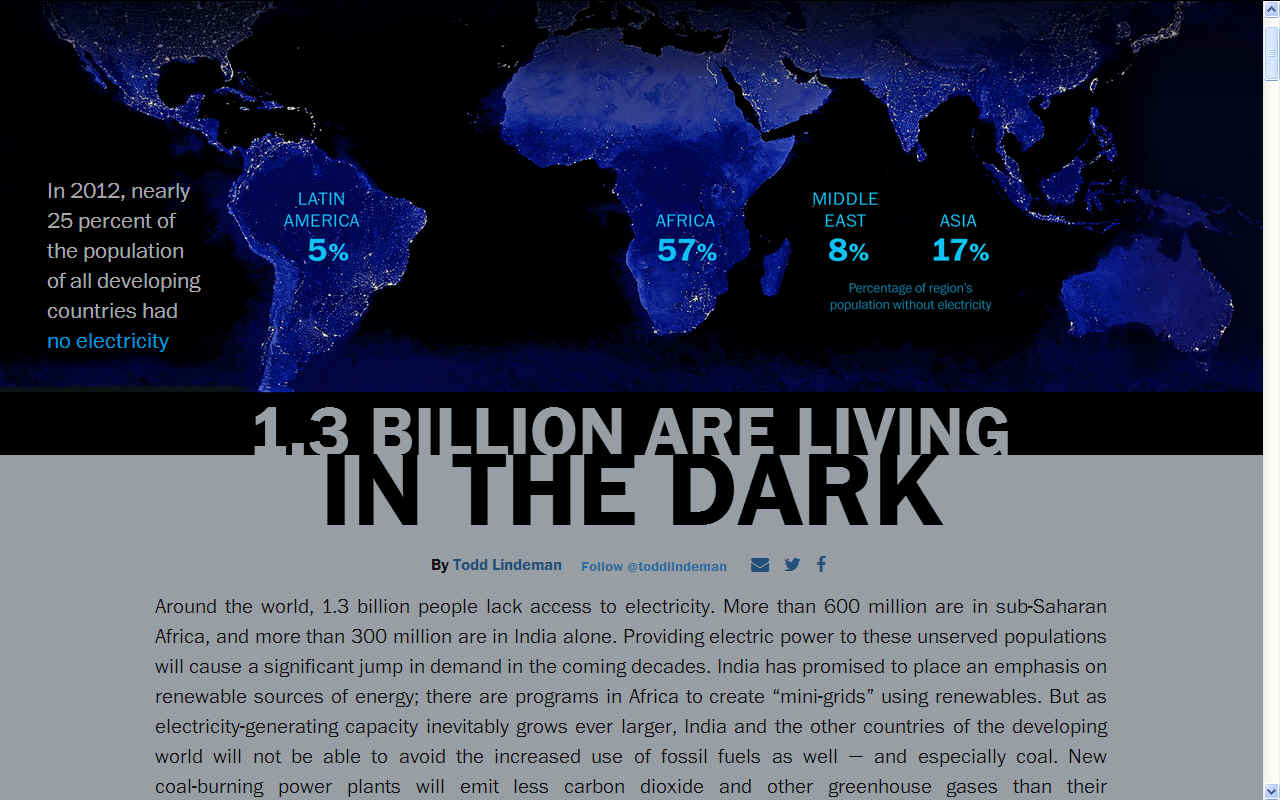
AFRICA
& INDIA - In
2015 a world report concluded that 1.3 billion people were living in the
dark. Rather than looking at this as a problem, we might take the
alternative view that this is an opportunity to build a sustainable off-grid supply
network using only renewables - so ensuring that what might be perceived as
more strain in terms of climate change, might be prevented. We might achieve
this with mobile units to begin with, until the affected regions have time
to build permanent networks with installed wind and solar
energy generators.
You
might argue that they are the lucky ones. If they do not get on the
development merry-go-round, they have nothing to lose. Once you join the
rat-race it is hard to go back to less energy intensive living. There is an
argument for not forcing change on tribes who are perfectly happy as they
are.
LONG TERM SECURITY
In
the short term we are reliant
on fossil fuels to take us into a
sustainable age where a circular economy is recognized as essential to
harmonious living. Long-term measures to increase energy security center on reducing dependence on any one source of imported energy, increasing the number of suppliers, exploiting native
fossil fuel or renewable energy resources, and reducing overall demand through energy conservation measures.
We
might also enter into international agreements to undermine fossil fuel energy trading
monopolies and assure that everyone has the right to cheap and clean
renewable energy, with the need to transport imports. Those
who held the power and wealth should consider re-investing in alternatives
as they head towards the sustainable economics of zero growth.
The deployment of renewable
energy technologies increases the diversity of electricity sources and contributes to the flexibility of
an international infrastructure system and its resistance to central shocks,
especially where off-grid installations are widely deployed, but can be grid
connected.
It
is likely to be that at some point in the future we will no longer need
power stations that run on coal, oil
or nuclear fuels. We will have dragged ourselves out of the fossil
fuel cesspit and taken power generation from the fortunate few who
profit from geological deposits, to the masses who only need a space to
mount the harvesting medium for energy independence.
For those countries
whose reliance on imported
gas is a significant
energy security issue, renewable technologies can provide
a level playing field.
As the fossil resources that have been so crucial to human advancement start declining in numbers, countries will
be glad that they changed over to renewable energy. 
FUSION | BIOFUELS
| GEOTHERMAL
| HYDRO-ELECTRIC
| SOLAR |
WAVE
& TIDAL | WIND
COMPRESSED
GAS - ECONOMY - FUEL
CELLS - FUSION
- HYDRIDES
- LIQUID GAS
FUSION
LINKS
& REFERENCE
Fusion:
Other Labs (Magnetic Confinement)
Fusion:
Research Worldwide
Germany
| Forschungszentrum
Jülich - Institute of Energy and Climate Research (TEXTOR
experiment) |
Karlsruhe
Institute of Technology (KIT), Nuclear Fusion Programme |
| Max
Planck Institute for Plasma Physics (IPP), Garching (ASDEX
experiment) |
Christian
Albrechts Univ. (CAU), Kiel, Plasma Dynamics Group |
| GSI
Darmstadt, Helmsholtz Centre for Heavy Ion Research |
Heinrich-Heine-Univ.
Duesseldorf, Inst. of Laser & Plasma Physics |
| Heinrich-Heine-Univ.
Duesseldorf, Inst. of Theoretical Physics |
Leibniz
Inst. for Plasma Science & Technology, INP
Greifswald |
| Ruhr-Univ.
Bochum, Inst. for Experimental Physics V |
Technical
Univ. of Darmstadt, Laser & Plasma Physics (site in
German) |
| Technical
Univ. of Dresden, IKTP, Inst. of Nuclear & Particle
Physics |
Univ.
of Augsburg, Inst. for Physics |
| Univ.
of Ruhr, Dept. of Physics & Astronomy |
Univ.
of Stuttgart, Inst of Interfacial Process Engineering
and Plasma Technology (TJ-K torsatron) |
| IPP
Greifswald (Wendelstein 7-X Experiment) |
Jülich
Supercomputing Centre (JSC) |
Italy
| Istituto
di Fisica del Plasma ENEA CNR, Milano |
Consortio
RFX Padova, ENEA (PRIMA facility) |
| RFX
Reversed Field Pinch Experiment, Padova |
Centro
Ricerche Frascati, ENEA (FTU Experiment) |
| Politecnico
di Torino, Condensed Matter Physics |
CMFD
Magnetofluiddynamics Consortium, Trieste |
| CREATE
Consortium (Consorzio di Ricerca per l'Energia e le
Applicazione Technologiche dell'Elettromagnetismo) |
Istituto
Nazionale di Ottica, Intense Laser Irradiation
Laboratory (ILIL), Pisa |
| Italien
National Agency for New Technology, Energy and
Environment (ENEA) |
IGNITOR
Experiment, ENEA, Frascati |
Japan
| QST
Naka Fusion Institute (home to ITER Japan) |
JT-60SA
Experiment |
| Broader
Approach R&D Center (IFMIF/EVEDA) |
National
Institute for Fusion Science (NIFS) (LHD Experiment) |
| Kyoto
University, Advanced Plasma Energy (Heliotron J
Experiement) |
Osaka
University, Institute of Laser Engineering |
| University
of Tsukuba, Plasma Research Center |
The
Japan Society of Plasma Science and Nuclear Fusion
Research |
| Ministry
of Education, Culture, Sports, Science and Technology (MEXT) |
Nagoya
University, Ohno Lab, HYBTOK-II Experiment |
| University
of Tokyo, Takase-Ejiri Laboratory (TST-2 Experiment) |
Tokyo
Institute of Technology, Laboratory for Advanced Nuclear
Energy |
| National
Institutes for Quantum and Radiological Science and
Technology (QST), Fusion Directorate |
Fusion
Energy Forum of Japan (QST) |
| Hanada
Laboratory (QUEST experiment) |
QST
Rokkasho Fusion Institute |
United Kingdom
| Culham
Centre for Fusion Energy CCFE (JET and MAST experiments) |
Engineering
and Physical Sciences Research Council (funding) |
| Imperial
College, London University, Plasma Physics Group |
Institution
of Mechanical Engineers |
| Queen's
University, Belfast, Centre for Plasma Physics |
United
Kingdom Atomic Energy Authority, UKAEA |
| University
of Glasgow, Astronomy & Astrophysics |
University
of Manchester, Dalton Nuclear Institute |
| University
of Manchester, School of Physics and Astronomy |
University
of Warwick, Centre for Fusion, Space and Astrophysics |
| University
of York, York Plasma Institute |
EUROfusion
(JET experiment) |
| Fusion
Centre for Doctoral Training (FUSION CDT) |
RACE
(Remote Applications in Challenging Environments) |
| University
of Manchester, Henry Royce Institute for Advanced
Materials |
Technological
Plasmas Research Group, University of Liverpool |
| Durham
Energy Institute, Materials for Fusion Energy |
Durham
University Centre for Advanced Instrumentation, Fusion
Diagnostics |
| University
of Strathclyde Glasgow, Physics |
University
of Liverpool, Faculty of Science and Engineering |
| University
of Oxford, Science and Technology of Fusion Energy |
University
of Oxford, Theoretical Astrophysics & Plasma Physics |
| University
of Bristol, Faculty of Engineering |
UKAEA
Fusion Technology Facilities |
| IOP
Institute of Physics, Plasma Physics Group |
United States (National
Laboratories)
| Argonne
National Laboratory, Engineering Development and
Applications, Illinois |
General
Atomics Magnetic Fusion Energy Research, San Diego (DIII-D
Experiment) |
| General
Atomics, Energy, San Diego |
Lawrence
Berkeley National Lab: Fusion Science and NDCX-II (Heavy
Ion Fusion Program) |
| Idaho
National Laboratory |
Lawrence
Livermore National Laboratory (LLNL), National Ignition
Facility |
| Los
Alamos National Laboratory, Fusion Energy Sciences |
Naval
Research Laboratory, Plasma Physics Division |
| Oak
Ridge National Laboratory (home to US ITER) |
Princeton
Plasma Physics Laboratory (PPPL), (LTX, NSTX-U
Experiments) |
| Sandia
National Laboratory, Albuquerque, New Mexico, Fusion
Energy Sciences |
Lawrence
Berkeley National Laboratory - National Energy Research
Scientific Computing Center (NERSC) |
| National
High Magnetic Field Laboratory |
Lawrence
Berkeley National Laboratory - Accelerator Technology
& Applied Physics Division |
| Lawrence
Livermore National Laboratory, Physical and Life
Sciences Directorate |
Los
Alamos National Laboratory, Plasma Physics |
| Innovation
Network for Fusion Energy (INFUSE) |
United States (Universities)
| Auburn
University, Alabama, Department of Physics. Auburn
Fusion Lab |
California
Institute of Technology (Caltech), Bellan Plasma Group |
| Columbia
University, New York, Applied Physics and Applied
Mathematics |
Columbia
University, New York, Plasma Physics Laboratory (HB-TEP
Experiment) |
| Cornell
University, Ithica, New York, Laboratory of Plasma
Studies |
Dartmouth
College, Department of Physics and Astronomy |
| Georgia
Institute of Technology, Atlanta, Fusion Research Center |
MIT
Plasma Science and Fusion Center (SPARC concept, Alcator
C-Mod, LDX Experiment) |
| Princeton
University, Graduate Program in Plasma Physics |
Rensselaer
Polytechnical Institute (RPI), Troy, NY, Plasma Dynamics
Laboratory |
| Swarthmore
College, Pennsylvania, Department of Physics and
Astronomy, Spheromak Experiment |
University
of California, Berkeley, Department of Physics |
| University
of California, Davis, Millimeter Wave Research Center |
University
of California, Irvine, Physics and Astronomy |
| University
of California, Los Angeles, Plasma Science and
Technology Institute |
University
of California, San Diego, ARIES program |
| University
of California, San Diego, Advanced Energy Technology
Group |
University
of California, San Diego, Center for Energy Research
(PISCES program) |
| University
of Colorado, Boulder, Center for Integrated Plasma
Studies |
University
of Illinois, Urbana/Champaign, Fusion Studies Laboratory |
| University
of Maryland, Center for Multiscale Plasma Dynamics |
University
of Maryland, Institute for Research in Electronics and
Applied Physics |
| University
of Michigan, Plasma, Pulsed Power, and Microwave
Laboratory |
University
of Rochester, NY, Laboratory for Laser Energetics |
| University
of Southern California, Los Angeles, Pulsed Power
Research Group |
University
of Texas, Austin, Institute for Fusion Studies |
| University
of Wisconson-Madison, Fusion Technology Institute |
College
of William and Mary, Physics |
| Florida
A+M University, Center for Plasma Science and Technology |
Florida
State University, National High Magnetic Field
Laboratory |
| University
of California, Davis/Sandia Laboratory collaboration:
Compact Toroid Injection project |
University
of Iowa, Department of Physics and Astronomy |
| University
of Montana, Plasma Physics Group |
University
of Washington, Plasma Science and Innovation Center |
| Utah
State University, Plasma Physics |
University
of Wisconson-Madison, Engineering Physics Department
(Pegasus Experiment) |
| University
of Wisconson-Madison, Center for Plasma in the
Laboratory (MST Experiment) |
University
of Wisconson-Madison, Fusion and Plasma |
| University
of California, Los Angeles, Fusion Science and
Technology Center |
University
of Rochester, NY, Fusion Science Center |
| Lehigh
University, Mechanical Engineering & Mechanics,
Laboratory for Control of Complex Physical Systems |
Michigan
Institute for Plasma Science and Engineering (MIPSE) |
International
Organizations
Fusion:
General Interest
Journals
|
https://www.cnbc.com/2019/03/06/bezos-microsoft-bet-on-a-10-trillion-energy-fix-for-the-planet.html
Please
use our A-Z
INDEX to navigate this site
|